
AI-Powered Web Application Development
AI-Powered Web Applications That Make Digital Experiences Smarter
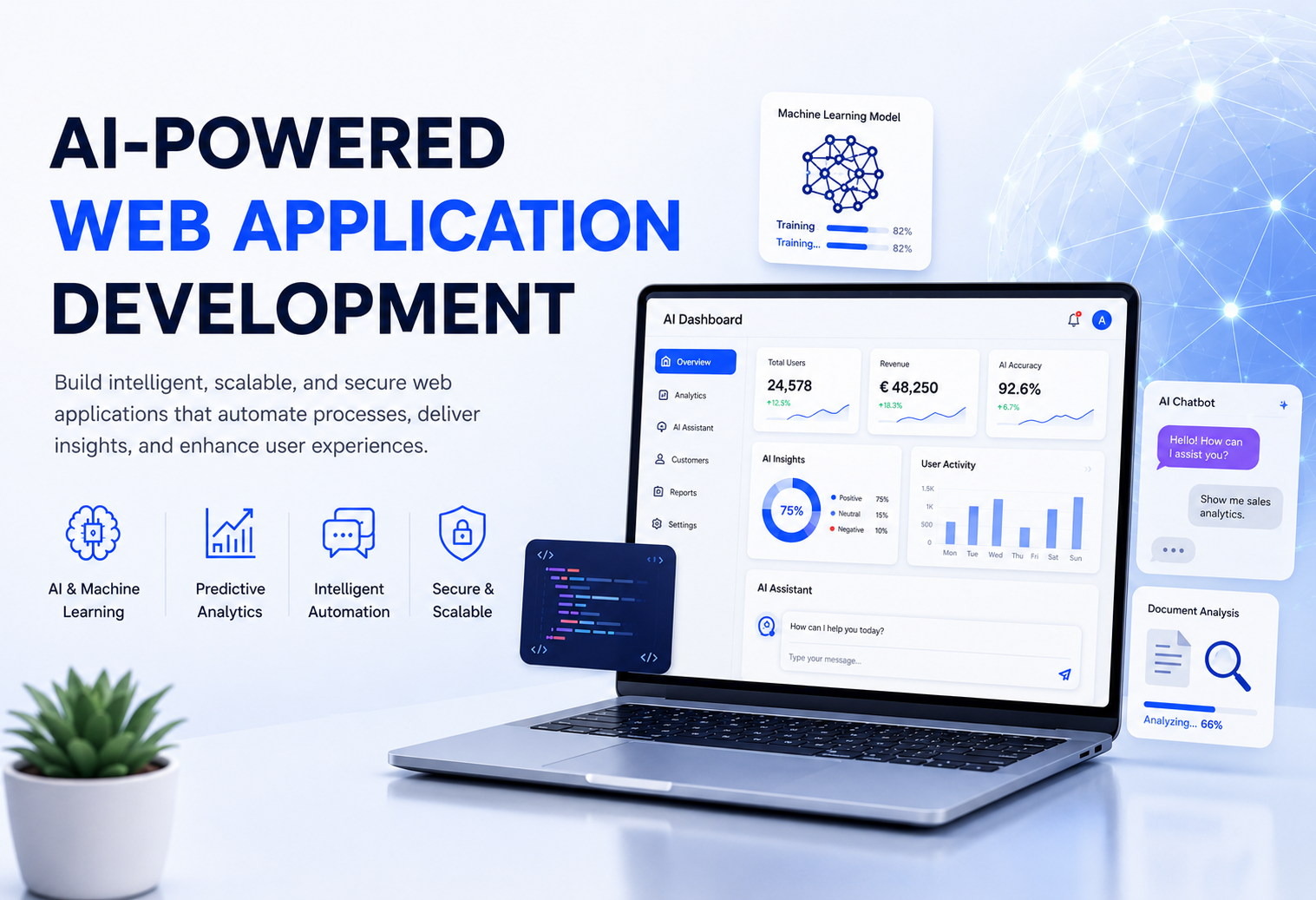
Qtech IT designs and develops AI-powered web applications that help businesses automate tasks, personalise customer journeys, analyse information, improve decision-making, and deliver intelligent digital services through the browser.
A successful AI web application should feel simple to use, even when the technology behind it is complex. We design intelligent web experiences that are practical, secure, fast, and connected to real business workflows.
Why Businesses Need AI-Powered Web Applications
Traditional web applications are designed to collect, display, and manage information. AI-powered web applications go further. They can understand user requests, identify patterns, generate useful content, recommend actions, automate workflows, and help people complete tasks faster. This allows businesses to create more valuable digital products without making the experience more complicated for users.
Visitors no longer want to search through large menus, long support pages, or complicated dashboards to find what they need. An AI-powered web application can guide users, answer questions, recommend suitable products or services, and adapt the experience based on context, behaviour, and preferences.
Employees often work across CRM platforms, shared drives, spreadsheets, email, ticketing systems, and internal portals. An intelligent web application can bring these workflows together and use AI to search information, prepare summaries, trigger actions, and reduce duplicate work.
Many business processes still depend on manually reading documents, checking information, writing replies, preparing reports, or entering data into another system. AI web application development can automate parts of this work while keeping approval and human review where necessary.
A custom AI web application can be designed around your own users, services, subscription model, workflows, integrations, permissions, and regional requirements. This gives your business more control over the experience, data, features, and future development.
AI Web Solutions Built for Real Business Use
We build customer-facing platforms, internal business systems, digital products, and SaaS applications with artificial intelligence integrated into the user journey. Each feature is designed to solve a clear problem and support a measurable business outcome.
Create secure customer portals where users can ask questions, manage services, upload documents, receive recommendations, track requests, and access personalised information. AI can reduce support pressure while helping customers complete tasks without waiting for manual assistance.
We build web applications that let users search approved documents, policies, product information, support content, or business knowledge through a conversational interface. Retrieval systems can provide source-based answers and limit access according to user roles.
Turn complex operational data into clear insights, summaries, forecasts, alerts, and recommended actions. Managers can understand what is changing, why it matters, and where attention is needed without manually reviewing multiple reports.
Develop browser-based tools for content generation, proposal writing, marketing assistance, document drafting, image workflows, product descriptions, internal communication, or other controlled generative AI use cases.
Combine AI with forms, approvals, background tasks, APIs, notifications, business rules, and user actions. This allows the web application to support complete processes instead of operating as a separate chatbot or isolated feature.
Launch an AI-powered SaaS product with user accounts, tenant management, subscription plans, usage limits, billing, administration, analytics, model controls, and secure cloud infrastructure designed for growth.
Everything You Need to Build a Successful AI Web Application
Our AI-powered web application development service covers product planning, user experience, software engineering, AI integration, testing, security, deployment, and long-term improvement. We build the full digital product rather than delivering only an isolated AI component.
-
 Web application discovery and planning: We define the users, workflows, business goals, AI opportunities, integrations, success criteria, and phased release plan.
-
Responsive UX and interface design: We create clear web experiences for desktop, tablet, and mobile browsers with a focus on usability and accessibility.
-
Frontend development: We build fast, maintainable interfaces using modern frameworks and reusable design components.
-
Backend and API development: Our team develops secure business logic, APIs, background processes, databases, file handling, and administrative features.
-
AI model and service integration: We connect suitable language models, machine learning services, vision systems, search tools, or custom AI components.
-
Authentication and role-based access: User accounts, permissions, departments, subscriptions, tenant separation, and administrative controls can be included.
-
Business system integrations: Connect CRM, ERP, payment, booking, email, communication, analytics, storage, identity, and other external platforms.
-
Testing and AI evaluation: We test functionality, usability, security, browser compatibility, performance, output quality, edge cases, and failure behaviour.
-
Cloud deployment and monitoring: We prepare scalable hosting, logs, alerts, backups, CI/CD pipelines, AI usage tracking, and production support.
-
Documentation and continuous development: We provide technical documentation and can continue improving the product after launch.
Business Outcomes an AI Web Application Can Support
AI web application development should be connected to clear operational and commercial goals. The value does not come from adding artificial intelligence to every screen. It comes from using the right intelligence at the points where users need faster answers, better guidance, less manual work, or more useful information.
AI can prepare summaries, classify requests, extract document data, generate first drafts, recommend next steps, and move information between approved systems. This helps employees spend less time on routine processing and more time on work that requires judgement, relationships, and service quality.
Intelligent search, guided forms, conversational support, and personalised recommendations can help customers complete common tasks without waiting for a team member. Complex or sensitive requests can still be transferred to a person with the relevant context already prepared.
A well-designed application can apply approved business rules, knowledge sources, templates, and workflows consistently. This can reduce variation between teams while still allowing authorised users to review, edit, approve, or override AI-supported recommendations.
AI can support entirely new services, subscription products, customer portals, industry-specific tools, and data-driven platforms. A scalable web architecture makes it possible to test a focused MVP, learn from real users, and expand the product with additional features, plans, integrations, and markets.
Technologies for Modern AI Web Application Development
We select technologies according to product goals, expected usage, integration requirements, security, performance, maintainability, and budget. The architecture is designed to support current needs without blocking future growth.
React, Next.js, Vue, Nuxt, Angular, TypeScript, Tailwind CSS, Bootstrap, and reusable design systems for responsive and accessible interfaces.
FastAPI, Django, Node.js, Laravel, Spring Boot, REST APIs, GraphQL, WebSockets, background workers, queues, and event-driven services.
OpenAI, Azure OpenAI, Anthropic, Gemini, Llama, Mistral, PyTorch, TensorFlow, scikit-learn, and specialised AI APIs.
PostgreSQL, MySQL, MongoDB, Redis, Elasticsearch, pgvector, vector databases, object storage, and secure file-processing pipelines.
OAuth, OpenID Connect, SSO, JWT, multi-factor authentication, role-based access, encryption, audit logs, input validation, and secure API controls.
AWS, Microsoft Azure, Google Cloud, Docker, Kubernetes, serverless services, CI/CD, observability, autoscaling, backups, and application monitoring.
AI Web Applications for Different Industries
AI web applications can support different customer journeys, operational processes, and digital business models. We adapt the platform to the needs of the sector, users, data, and regulatory environment.
AI booking portals, customer assistants, service recommendations, workforce dashboards, operational automation, review support, and multilingual communication.
Secure patient or client portals, administrative support, document workflows, scheduling, knowledge access, staff assistance, and controlled communication tools.
AI learning platforms, tutor interfaces, content support, assessment workflows, student self-service, knowledge systems, and administrative automation.
Client portals, proposal tools, research assistants, document review, onboarding systems, knowledge applications, and case management support.
AI product discovery, personalised recommendations, shopping assistants, intelligent search, customer support, content generation, and demand insights.
Secure dashboards, document processing, risk indicators, reporting support, client self-service, workflow automation, and internal decision tools.
Our AI-Powered Web Application Development Process
We follow a structured process that connects product strategy, web development, AI engineering, security, and user experience. This keeps the project focused on a usable business product rather than a technical demonstration.
We review the business model, target users, customer journey, internal workflows, current systems, data sources, AI opportunities, risks, and expected results.
We define user flows, screens, modules, access levels, integration points, database structure, AI behaviour, model strategy, data permissions, and technical architecture.
We can create a clickable interface, focused prototype, or proof of concept to validate the user experience, model quality, integration approach, and operating cost before full implementation.
Our team develops the frontend, backend, database, APIs, admin tools, AI services, payment or subscription features, and third-party integrations in manageable delivery stages.
We test browsers, devices, performance, permissions, integrations, error states, accessibility, AI output quality, unsupported answers, prompt-related risks, and other relevant scenarios.
We deploy the application, monitor usage and failures, support users, optimise cost and performance, and continue improving the web product based on real feedback and business priorities.
Why Businesses Trust Qtech IT for AI Web Development
Qtech IT brings together web engineering, artificial intelligence, product design, cloud infrastructure, and business software experience. We build complete applications that are useful for customers, manageable for administrators, and ready for future development.

One team can manage product planning, UI/UX, frontend, backend, databases, APIs, AI, cloud, DevOps, security, and integrations.
We make AI functions clear and useful for non-technical users. The application is designed around tasks, decisions, and customer journeys rather than model terminology.
Based in the Netherlands, we consider GDPR-conscious data flows, access control, auditability, accessibility, and the expectations of European and international users.
Applications can begin with a focused MVP and grow with more users, tenants, modules, languages, models, integrations, countries, and subscription plans.
We keep project scope, technical decisions, limitations, progress, and next steps clear so stakeholders can make informed decisions.
We can continue monitoring, maintaining, optimising, and expanding your AI web application after launch.
Frequently Asked Questions About AI-Powered Web Application Development
An AI-powered web application is browser-based software that uses artificial intelligence to support functions such as search, generation, recommendations, prediction, classification, automation, document processing, or conversational interaction.
Yes. We can assess your current frontend, backend, APIs, database, authentication, and hosting environment, then add suitable AI features without rebuilding the entire product where the existing architecture allows it.
Common features include AI chat, knowledge search, content generation, document extraction, intelligent recommendations, predictive analytics, automated support, workflow assistance, image analysis, classification, summarisation, and decision support.
Yes. We can build multi-tenant architecture with separate organisations, users, roles, settings, subscriptions, domains, data boundaries, usage limits, and administrative controls.
Controls may include approved knowledge sources, retrieval-augmented generation, structured prompts, validation rules, confidence thresholds, source references, restricted actions, human approval, fallback behaviour, logging, and regular evaluation.
Yes. We design responsive web applications that work across modern desktop, tablet, and mobile browsers. A progressive web app or separate mobile application can also be considered when device-specific functionality is required.
A focused prototype may take several weeks, while a complete production platform can require several months. The timeline depends on features, users, integrations, data readiness, AI complexity, security, and testing requirements.
Yes. We can provide maintenance, monitoring, security updates, model adjustments, performance optimisation, new integrations, additional modules, and continued product development.
Build an AI Web Application That Creates Real Business Value
Whether you need an intelligent customer portal, an internal AI workspace, a generative AI platform, a smart dashboard, or a complete AI SaaS product, Qtech IT can help you design, build, launch, and improve the application.
